Justin Herbert Has Been Waiting for This. So Have Chargers Fans.
Let’s be honest about what we’ve watched in Los Angeles for the past few years.
Justin Herbert is one of the most physically gifted quarterbacks in the NFL. He can make every throw on the field, absorbs punishment like few quarterbacks his size ever have, and has done it all while getting hit more than almost anyone in the league. Last season he was sacked 54 times, second most in the NFL, faced a league-high number of pressures, played the final month with a fractured left hand, and still managed to lead the Chargers to the playoffs before a 16-3 loss to New England in the Wild Card round.
The Chargers have had a Herbert problem for years. Not with Herbert. With the people around him.
This offseason, Jim Harbaugh and general manager Joe Hortiz did something about it.
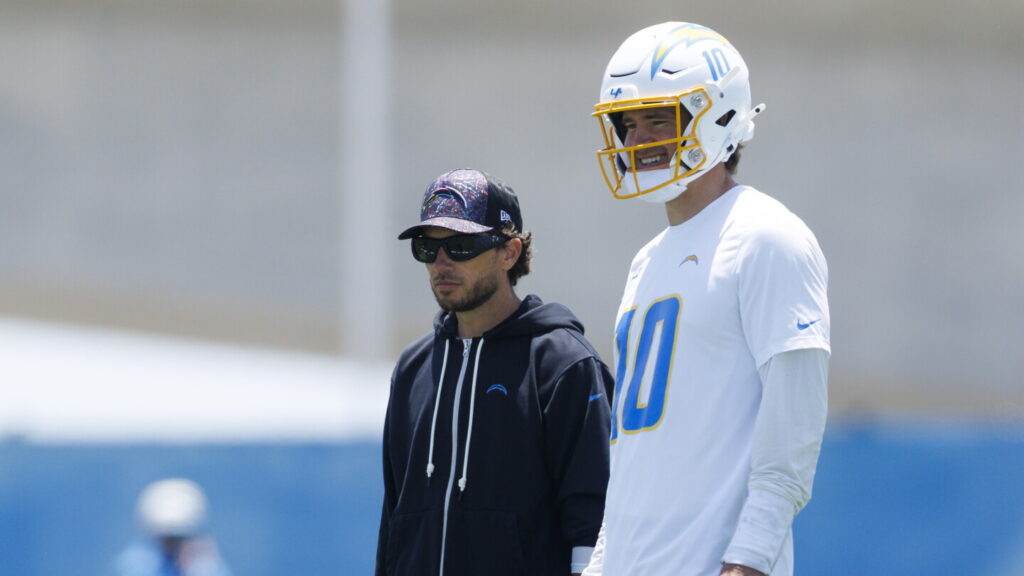
Enter Mike McDaniel
The most significant move of the Chargers’ offseason had nothing to do with the draft or free agency. It was the decision to replace offensive coordinator Greg Roman with Mike McDaniel, one of the most creative offensive minds in football.
McDaniel built his reputation in San Francisco and Miami implementing wide zone run schemes that create explosive plays, quick throws, and favorable matchups throughout the field. His offenses consistently rank among the league’s most dynamic, and the early returns with Herbert have been better than anyone expected.
McDaniel has already made one immediately visible change. He switched Herbert’s shotgun stance so that his left foot is forward rather than his right, a footwork adjustment designed to speed up his release and get the ball to receivers earlier. It sounds like a small thing. McDaniel says it isn’t. He has implemented the same change at every previous stop including Washington, Atlanta, and Miami, and his study of the technique dates back to his time with Kyle Shanahan in Houston, where he found quarterbacks who made the switch became measurably more efficient.
Herbert bought in completely. He told reporters during minicamp that McDaniel has a feel for the quarterback position unlike any coach he’s worked with, and that the more time the two spend together the better the offense will be. McDaniel responded by saying Herbert has exceeded his early expectations and that the goal is to get Herbert to the next level of his career in 2026.
That’s not organizational hype. That’s a coach who has seen a lot of quarterbacks telling you this one is special.
The Offensive Line Finally Gets Fixed
The other piece that has plagued Herbert throughout his career is the offensive line. Last season’s 54 sacks and league-high pressure numbers were a direct result of an inconsistent, injury-riddled group that went through numerous combinations and never found stability.
This offseason the Chargers addressed it directly. They signed Pro Bowl center Tyler Biadasz to anchor the interior, a move McDaniel specifically prioritized to give Herbert a steady presence at the most important position on the line. Biadasz brings veteran leadership and consistency to a group that desperately needed both.
Left tackles Rashawn Slater and Joe Alt both return healthy after injury-plagued seasons, giving Herbert two of the better bookend tackles in the conference when fully operational. Slater in particular is considered one of the elite left tackles in football when healthy and his return to full strength is one of the most important storylines heading into camp.
McDaniel’s wide zone scheme also helps in ways that aren’t immediately obvious. The outside zone run game forces defenses to defend the entire width of the field horizontally, which creates natural running lanes and limits the angles pass rushers can take to the quarterback. Herbert himself noted that getting the ball out quickly under McDaniel’s system takes the pass rush out of the equation more effectively than anything a protection scheme can draw up.
The Weapons Are Real
Herbert has never had a receiver room this complete and this fast.
Ladd McConkey emerged as one of the league’s most exciting young receivers last season and is returning healthy after a hamstring issue limited him late in the offseason program. McDaniel has already spoken about using McConkey’s quickness and after-catch ability as a cornerstone of the quick passing game. Second-year running back Omarion Hampton gave the Chargers a legitimate ground threat last season and is projected to thrive in McDaniel’s wide zone scheme. Quentin Johnston enters year four with McDaniel already comparing his traits to Julio Jones and Andre Johnson, high praise from a coordinator who has coached a lot of elite receivers.
David Njoku signed as a free agent tight end, giving Herbert a legitimate seam threat and a reliable chain-moving option he hasn’t consistently had at the position. The tight end room now includes Njoku, Oronde Gadsden, and Charlie Kolar, giving McDaniel multiple personnel groupings to create mismatches.
Put it all together and this offense should look very different from what we watched last season. Faster. More explosive. With Herbert getting the ball out quickly rather than standing in a crumbling pocket waiting for routes to develop downfield.
The Defense Returns Strong
The Chargers weren’t just an offensive disappointment last year. The defense was legitimately good. Safety Derwin James signed a contract extension this offseason, keeping one of the most versatile defenders in the conference in Los Angeles. The unit finished as one of the better defenses in the AFC and returns largely intact under new coordinator Chris O’Leary.
Tuli Tuipulotu made his first appearance on the NFL’s Top 100 players list heading into 2026, and CBS Sports recently called the Chargers’ defense one of the better units in the conference heading into training camp. This is not a team that has to win every game 35-31. It has a defense capable of keeping things close while the offense figures out its new identity.
The Same Old Question
Here’s where we have to pump the brakes just slightly. The Chargers have been here before. Not this exactly. But the promise has always been there.
Herbert is extraordinarily talented. The roster has always had real pieces. And yet the Chargers have found ways to fall short when it mattered most. The Wild Card loss to New England was the latest entry in a growing list of playoff disappointments for an organization that hasn’t won a postseason game since the 2022 season.
McDaniel is a genuine upgrade over what came before. The offensive line is better on paper. Herbert is healthy and engaged in a new system that appears to be a genuinely great fit for his skill set.
But the AFC West is not waiting around for Los Angeles to figure it out. Denver is the defending champion. Kansas City has Mahomes working his way back. The Chargers are right in the middle of a three-team race that is going to come down to execution in the moments that matter.
Training camp opens July 29. That’s when the real work begins.
The Bottom Line
If Mike McDaniel is as advertised, if Herbert gets the ball out faster and stays upright behind a healthier offensive line, and if the weapons around him perform the way the coaching staff believes they can, this is a legitimate Super Bowl contender. ESPN’s Football Power Index recently ranked the Chargers ninth in odds to win it all. That feels about right as a floor.
The ceiling is higher. Herbert is that good. The pieces are that much better than they’ve been.
But Los Angeles has to actually do it. Not in minicamp. Not in the preseason. In January, when it counts.