Miami Dolphins 2026: An Organization Still Searching for Its Identity
Here’s a question worth asking before training camp opens in Miami Gardens.
What exactly are the Dolphins trying to be?
They released Tua Tagovailoa. They traded Jaylen Waddle. They cut Tyreek Hill. They hired a first-year NFL head coach in Jeff Hafley and a first-year NFL general manager in Jon-Eric Sullivan, both imports from the Green Bay Packers organization. They signed Malik Willis to a three-year, $67.5 million deal to play quarterback. And they’ve openly committed to a build-through-the-draft approach after years of big-ticket free agent spending.
People are calling this a rebuild. That’s generous. This is starting over from scratch.
The Malik Willis Question
Let me be upfront about where I stand on this.
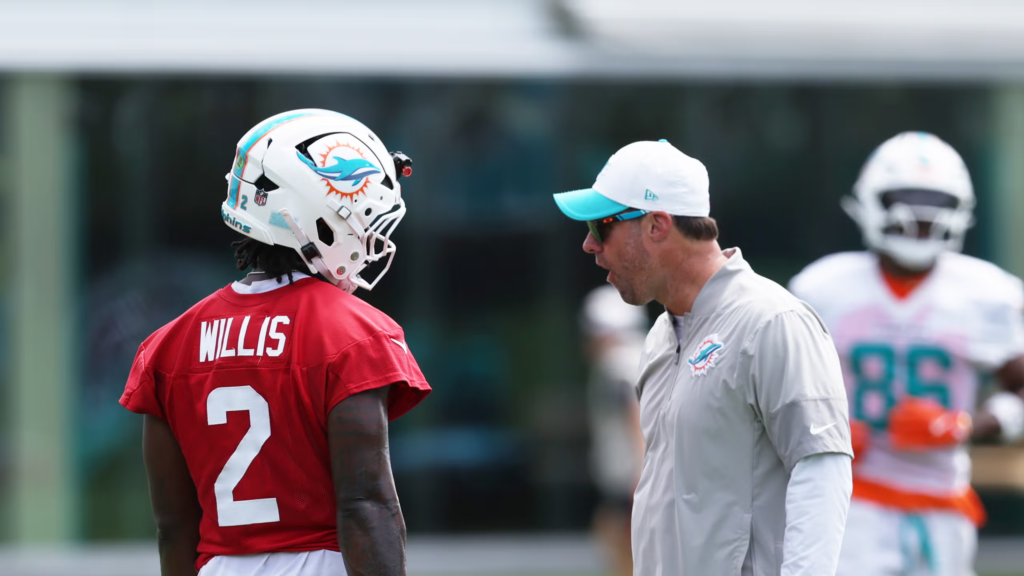
Willis is not a franchise quarterback. He’s a guy with elite athleticism, a strong arm, and one very good stretch of football in Green Bay as a backup. His career numbers as a starter tell a different story. He posted a 49.4 QB rating across two seasons as a starter with a bad Tennessee Titans team. That’s the most extended sample we have of Willis under pressure, and it is not encouraging.
His Green Bay numbers were genuinely impressive, an 86.3 QBR and 9.2 yards per dropback in a limited role. But there’s a massive difference between playing well in a handful of games as a backup behind a well-constructed roster and being the guy every week for a team that just gutted its skill positions.
ESPN’s Seth Walder graded the Dolphins an A-minus this offseason, largely driven by the Willis signing. He called it a “risk worth taking” given Willis’s upside. I respect that take. I just don’t share it. Bleacher Report’s Kristopher Knox put it more bluntly, identifying Willis as one of eight quarterbacks most likely to be benched in 2026, pointing out that Miami 2026 looks a lot more like Tennessee 2022 than Green Bay 2024. The supporting cast around him is closer to what dragged his numbers down in Tennessee than what propped them up in Green Bay.
The honest framing here is that Willis is a placeholder. He might be a decent one. De’Von Achane re-signed on a long-term deal and remains one of the most explosive running backs in the league, and the Willis-Achane read-option tandem could generate some highlights. But Willis being a highlight reel and Willis being a franchise quarterback are two different things.
Quinn Ewers is sitting right behind him on the depth chart. He’s a second-year player with three NFL starts and legitimate collegiate pedigree. If Willis struggles, that conversation is going to happen fast.
The Receiver Room Is as Thin as Advertised
This is where it gets genuinely painful. Without Hill and Waddle, Miami’s receiving corps is Malik Washington, Tutu Atwell, Jalen Tolbert, and a collection of rookies that includes third-round picks Caleb Douglas and Chris Bell and slot receiver Kevin Coleman Jr.
NFL.com called it a “who’s who of who’s that.” That’s not wrong.
Hafley acknowledged at minicamp that the chemistry between Willis and his receivers is still very much a work in progress, saying plainly that it would “take a lot of reps” and “take time.” That’s a reasonable thing to say in June. It’s a less comfortable thing to hear when the depth chart behind your starting quarterback has no proven pass catchers.
CBS Sports was equally blunt, writing simply that Willis has “arguably the NFL’s worst supporting cast.” As a Browns fan who spent years watching some historically bad receiver rooms, I don’t say this lightly. Miami’s group might actually be worse than what we endured in Cleveland during the lean years. At least we had some veterans who could get open occasionally.
So What Is the Plan Here?
Here’s what I actually think is going on, and I think it’s the right move even if it’s painful to watch.
Miami is tanking. Not openly. Not in the way a front office will ever say publicly. But the 2027 quarterback draft class is shaping up to be one of the strongest in years, with Arch Manning, Dante Moore, and others expected to be available. The Dolphins have the third-most cap space in the NFL heading into 2027, according to OverTheCap. They have draft picks. They have a plan.
Willis is the bridge. If he surprises everyone and plays well, great. The rebuild accelerates. If he struggles behind a roster that was always going to make struggling look likely, Miami positions itself for a top-five pick and a chance to land the long-term answer at quarterback in a loaded draft class.
That’s not a bad strategy. It’s actually a reasonable one. It’s just not a fun season to watch.
The Bottom Line
Jeff Hafley and Jon-Eric Sullivan are building something in Miami. Whether they’re building the right thing remains to be seen. The Packers organization they came from has been a model of quiet, sustained competence for decades, and bringing that culture to South Florida is the explicit goal.
But Green Bay had Aaron Rodgers. And before that, Brett Favre. The Packers built their dynasty around generational quarterbacks, not bridge starters on three-year deals.
Until Miami finds its version of that, everything else is just infrastructure.
Training camp opens at the Baptist Health Training Complex in Miami Gardens. The questions will far outnumber the answers. For Dolphins fans, the most important thing to watch isn’t whether Willis wins the starting job. It’s whether this team loses enough games in 2026 to put themselves in position to find the guy who actually changes everything.