Oklahoma Sooners Are Champions, and Nobody Saw It Coming
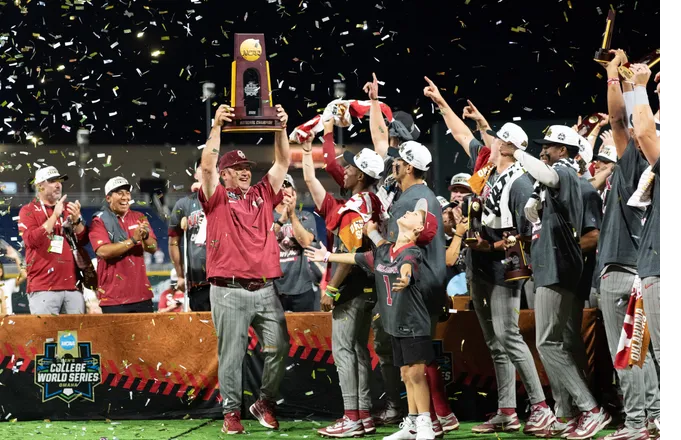
Nobody put Oklahoma in their Omaha bracket.
The Sooners finished 14-16 in SEC play, ranked 11th in the conference during the regular season. They lost to LSU in the SEC Tournament. Their record entering the NCAA Tournament was 32-21, the kind of number that gets teams bubble conversations, not national championship ones.
And yet, on Monday night at Charles Schwab Field in Omaha, Oklahoma steamrolled North Carolina 13-2 in a winner-take-all Game 3 to win the 2026 Men’s College World Series, claiming the program’s third national title in history and its first in 32 years. They finished 43-23 overall.
Boomer Sooner, indeed.
The Road to Omaha Nobody Believed In
Here’s what makes this run genuinely remarkable. Once the NCAA Tournament started, Oklahoma didn’t just get hot. They got dominant.
The Sooners went 11-2 across 13 tournament games, knocking out a murderer’s row of national seeds along the way. They beat No. 2 overall seed Georgia Tech in the Atlanta Regional. They swept No. 15 Kansas in the Super Regional. In Omaha, they knocked off No. 7 Alabama and No. 3 Georgia to reach the finals, then beat No. 5 North Carolina twice to close it out.
Three top-five seeds beaten in Omaha alone. A team that went 14-16 in the SEC turned into a juggernaut the moment the postseason began.
Shortstop Jaxon Willits, who was named the Most Outstanding Player of the tournament, summed it up well in the postgame celebration. “I think we knew that the talent was always in the room,” he said. “Whether we were playing well or not, we believed that we had the talent in the room to go out and win a national championship.”
That belief showed up every single night in Omaha. Oklahoma scored first in every game at the College World Series, going 5-1 overall.
Game 3: A Masterclass
The championship game itself wasn’t close. Oklahoma jumped out to a 2-0 lead in the second inning, added a third run in the third, and simply never stopped.
The fourth inning is where the Tar Heels’ chances effectively ended. Three consecutive one-out walks loaded the bases against UNC reliever Walker McDuffie. North Carolina turned to star freshman Caden Glauber, who had been nearly unhittable all season with a 29-0 record in appearances. Jaxon Willits greeted him with a two-run single, and the floodgates opened.
The dagger came in the eighth. With Oklahoma already in control, Kyle Branch hung a curveball over the plate and launched it into the seats for a three-run home run, finishing off a remarkable three-hit, six-RBI night out of the nine hole. Branch’s performance was the kind of thing championship legends are made of.
LJ Mercurius held North Carolina scoreless for the better part of five and two-thirds innings out of the bullpen, allowing just one run on four hits with five strikeouts. Freshman Jackson Cleveland came in to finish it, striking out the final three batters he faced to seal the title in front of 23,248 fans.
Skip Johnson’s Moment
Head coach Skip Johnson has been building toward this in Norman for nine years. He brought Oklahoma to the finals once before, losing to Ole Miss in 2022, and this time he left no doubt.
Two of his players, including shortstop Jaxon Willits, were on that 2022 roster too. Willits’ own father, Reggie Willits, was an assistant coach on both teams. There’s a continuity and a culture here that doesn’t happen by accident.
Johnson himself put it best after the final out. “I don’t worry about history, I think people know that about me, but if you say we made some, I’m not going to give it back,” he said. “What I do know is how hard these guys worked. How we all work. People don’t see that. Team meetings and talks and workouts. All the stuff that gets you to a place like tonight. Maybe people overlook you. If you have a good group, you don’t care about that. Because if you take care of your business and do it the right way, they can’t overlook you then.”
A Little History Worth Knowing
This is Oklahoma’s third Men’s College World Series title, joining championships from 1951 and 1994. The 1951 title has one of the stranger stories in college baseball history.
Athletic director and football coach Bud Wilkinson didn’t think the team was good enough to be in Omaha and refused to pay for the trip until the university president intervened. The Sooners swept their way to the title, defeating heavily-favored Tennessee in the finals, then loaded their trophy into a school bus and drove 500 miles back to Norman because they didn’t have enough money for a hotel room. Players didn’t receive their championship rings until 2001.
The 2026 title also makes Oklahoma just the 10th program in history to win three or more baseball national championships. And it extends the SEC’s remarkable winning streak: Oklahoma is the seventh straight SEC program to win the Men’s College World Series.
North Carolina, for their part, remains the greatest program to never win it all. The Tar Heels are now 0-3 in Men’s College World Series finals over the past 20 seasons, having also lost to Oregon State in 2006 and 2007. They came in at 54-14-1 this year, one of the best records in the country. Sometimes college baseball just works that way.
Why This Championship Matters
College baseball doesn’t always get its moment in the spotlight, and Oklahoma wasn’t exactly the story anyone was writing about heading into June. But that’s exactly what makes this run so compelling.
This wasn’t a preseason favorite validating their expectations. This was a team that nobody outside of Norman believed in, taking down the best programs in the country one by one, doing it with a coach who promised he wasn’t going to quit, and delivering a championship that’s been 32 years in the making.
That’s a good story no matter who you root for.