The US Men’s National Team Got Exactly What They Deserved Against Belgium
Let’s not sugarcoat this.
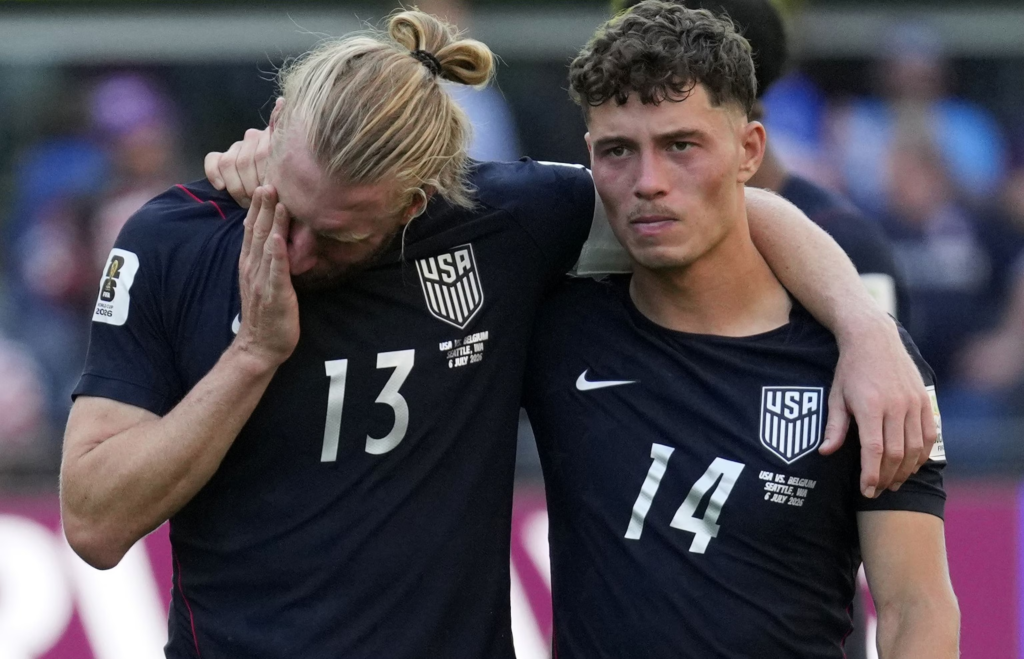
The United States Men’s National Team lost 4-1 to Belgium in the Round of 16 at the 2026 FIFA World Cup on Monday night at Lumen Field in Seattle. It wasn’t close. It wasn’t a valiant effort that fell short. It was a team that walked onto the field looking like they had already won something, got punched in the mouth in the ninth minute, and never recovered.
Belgium didn’t even have Kevin De Bruyne or Jeremy Doku in the starting lineup. Two of their best players sat out. And they still beat us by three goals without breaking much of a sweat. Let that sink in for a moment.
The Balogun Distraction Was Real
The entire week leading into this match was consumed by one topic. Folarin Balogun received a red card in the Round of 32 win over Bosnia-Herzegovina and faced an automatic one-game suspension that would have kept him out against Belgium. Then FIFA, in an unprecedented and controversial decision, overturned the suspension and allowed him to play.
The US team and the media around them treated that ruling like a championship trophy.
You could feel it in the energy around the program all week. The focus wasn’t on Belgium’s defensive shape or how to exploit their wide areas. It was on winning an argument about a red card. Captain Tim Ream said after the match that the controversy had no impact on the team’s preparation and that they were fully focused. With respect to Ream, the performance on the field told a different story.
And here’s the punchline. Balogun barely factored in the match at all. After spending an entire week fighting to get him on the field, the US got virtually nothing from their leading scorer. When Tyler Adams was asked whether Balogun’s presence made a difference, he essentially shrugged and said “Was anyone a major presence on the field today?” That quote tells you everything.
And Then It Got Bigger Than Soccer
Before we even get to what happened on the field, it’s worth acknowledging just how much larger this situation became in the days leading up to Monday night.
President Trump confirmed publicly from the Oval Office on Monday that he personally called FIFA President Gianni Infantino to ask for a review of Balogun’s red card. “I asked for a review because I didn’t think it was a foul,” Trump said. He also acknowledged during the same remarks that “I didn’t know what the hell a red card was” when he first heard about the situation. After FIFA overturned the suspension, Trump praised it on Truth Social as FIFA “doing what was right and reversing a great injustice.”
Infantino confirmed the call in a statement on X, but was careful to say that FIFA’s independent judicial bodies made the decision autonomously and that he always upholds their authority. The US government also provided additional evidence to FIFA’s disciplinary committee as part of the process, according to a US official cited by multiple outlets.
UEFA, European soccer’s governing body, didn’t accept that framing. They called the reversal “unprecedented, incomprehensible and unjustifiable” and said FIFA had “crossed a red line.” The Belgian Football Association formally challenged Balogun’s eligibility, only to be told their challenge was inadmissible on procedural grounds. FIFA essentially ruled that Belgium had no standing to appeal a decision about an opponent’s player.
Now, as of Tuesday, a group of European Parliament lawmakers led by Barry Andrews, Lara Wolters, and Niels Fuglsang are circulating a letter calling for a formal investigation into Infantino’s role in the reversal and whether political pressure from the US administration influenced the decision. The letter is addressed to the 27 football associations of the European Union and asks them to formally request that the FIFA Ethics Committee investigate the matter. More than 35 MEPs had signed on as of Tuesday afternoon, with the deadline for signatures set for Wednesday evening.
“The beauty of sport is that it is based on impartial and transparent rules,” the lawmakers said in a joint statement. “When Infantino allows political pressure to determine who gets to play, this sense of fairness goes out the window.”
Here’s the thing. All of this happened before kickoff. The US team spent the week at the center of one of the biggest controversies in World Cup history. And then they went out and lost 4-1 to a Belgium team that didn’t have two of its best players in the starting lineup.
Whatever your view is on the red card itself, on whether the reversal was right or wrong, the outcome on Monday night rendered the entire controversy moot in the most painful way possible. All of that noise, all of that drama, all of that political intervention, and the US still couldn’t score more than once against a Belgium side missing Kevin De Bruyne and Jeremy Doku.
That is the part that stings the most.
They Had No Answer for Belgium
From the opening kickoff, the US looked disorganized and overmatched. Belgium scored in the ninth minute after the American defense failed to clear the ball out of the box. Malik Tillman gave the crowd a brief moment of hope with a free kick equalizer, a genuinely beautiful goal and his second direct free kick score of the tournament. It lasted less than two minutes before Belgium scored again.
The pattern of the match was painful to watch for anyone who cares about this program. The US was outmuscled in midfield, gave the ball away constantly, and seemed to have no coherent plan for how to play against a team pressing them with pace and physicality. Goalkeeper Matt Freese made a brutal error on Belgium’s third goal. Romelu Lukaku added a fourth in stoppage time to put an exclamation point on the evening.
What was most frustrating wasn’t the score. It was the style of the defeat. At times the US looked like a collection of individuals playing one-on-one soccer while Belgium played as a coordinated unit of eleven. When you’re the home team in a World Cup and you get outworked on the basics of team shape and defensive organization, that’s a coaching and preparation failure as much as a talent failure.
Pochettino said afterward “Today we didn’t show our real quality.” Adams said “Tonight was not a good performance overall. There were a lot of things that we could have done better.” Those are honest assessments. They’re also somewhat unsatisfying from a fan’s perspective when the biggest game of the tournament is the one where you choose not to show your real quality.
Let’s Be Fair About What This Team Did Accomplish
Here’s where I want to be honest, because the picture isn’t entirely bleak.
This US team made genuine program history at this World Cup. They won Group D with victories over Paraguay and Australia, beat Bosnia-Herzegovina in the Round of 32 for the first knockout stage win since 2002, and accumulated three total wins across the tournament, the most by any US men’s squad in World Cup history. Malik Tillman became the first USMNT player to score in consecutive World Cup knockout stage matches. Pochettino finished the tournament with more wins than any US manager in World Cup history.
Those aren’t small things. For a program that has spent decades trying to establish itself on the world stage, those are real markers of progress.
But here’s the reality check that matters most. Belgium, the team that just beat us by three goals, will almost certainly lose to Spain in the quarterfinals. Spain is one of the two or three best teams in this entire tournament. So what does that tell you about where the US actually stands in the global pecking order right now?
It tells you that this team was probably playing at or near its ceiling in the early rounds. The wins over Paraguay, Australia, and Bosnia were legitimate and hard-earned. But when a European team with real technical quality showed up and pressed with intensity from the opening whistle, the US had no answers. And that gap in quality, the gap between winning group stage games and competing with the genuine elite of world soccer, is still very much real.
What Comes Next
The conversations about the future of this program will begin immediately, and they should be honest ones. Pochettino has done genuine work building this group. The young talent at the foundation of this team is real. Christian Pulisic, Malik Tillman, and others represent a core that can continue to develop.
But the style of defeat on Monday night suggested that there are still fundamental tactical and organizational questions about how this program prepares for the moments that matter most. Spending a week fighting about a red card instead of preparing to beat Belgium is not the mentality of a program ready to take the next step. Getting outworked and outmuscled by a team missing two of its best players is not a sign of a program that has arrived.
The US got further in this World Cup than they have in 24 years. They should acknowledge that. And then they should be honest about how far they still have to go.
Monday night in Seattle was a hard lesson. The question is whether this program learns from it.