Titans: Is Year Two the Year Cam Ward Actually Gets to Show What He Can Do?
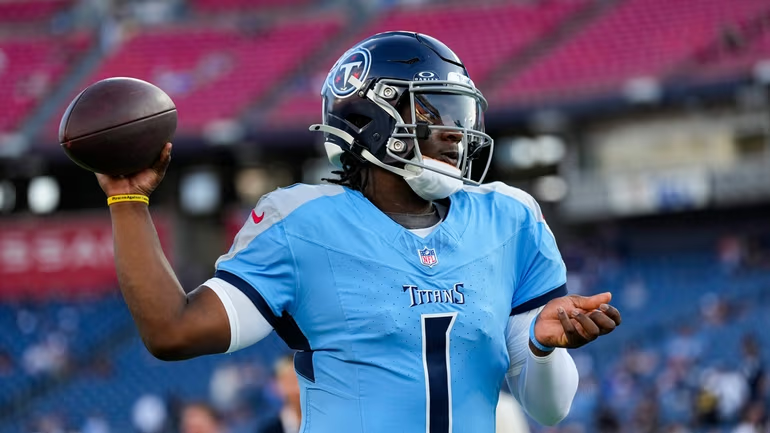
Cam Ward’s rookie season was rough. There’s no way to sugarcoat it.
He threw for 3,169 yards with 15 touchdowns and seven interceptions, which on the surface doesn’t look catastrophic. But the full picture is harder to swallow. He took 55 sacks, second-most in the entire NFL. He fumbled 11 times, losing a league-high seven of them. The Titans went 3-14 for the second straight year. They fired their head coach midseason. They cycled through multiple offensive coordinators before the season was even over.
Here’s the thing that makes Ward’s situation genuinely different from most rookie quarterback disasters, though. The problems around him were real, documented, and significant enough that most analysts who watched closely didn’t walk away convinced he was the problem.
His receivers dropped 24 passes, ranking 26th in the league. The offensive line allowed an NFL-high 13 unblocked sacks. His on-target percentage ranked 31st, in part because the scheme he was running ranked near the bottom of the league in deep ball attempts, just 8.1% of his throws traveled 20-plus yards. And the coaching staff he started the year with was gone before Thanksgiving.
What’s actually encouraging is how Ward finished. He threw just one interception over his final nine games. He put up his best statistical performance of the season in Week 12 against a Mike Macdonald defense that had been shutting down veteran quarterbacks all year. The arrow was clearly pointing up by the time the season ended, even if the record didn’t reflect it.
Now the Titans have actually built something around him.
Robert Saleh is the new head coach, and his first hire was Brian Daboll as offensive coordinator. The Daboll connection is genuinely significant. He helped develop Josh Allen from a raw, inaccurate thrower into a perennial MVP candidate in Buffalo. He watched every one of Ward’s college throws leading up to the 2025 draft and reportedly tried to trade up to the number one pick when he was still coaching the Giants. This isn’t a coordinator who inherited a quarterback. This is a coordinator who wanted this specific quarterback.
Daboll’s approach with Ward has been methodical from the start. He’s spent extensive time in the film room with his quarterback, trying to see the game through Ward’s eyes rather than just installing a system and expecting Ward to adapt. Ward himself has said Daboll is a “perfect fit,” and that he’s focused on understanding not just what play is being called but why Daboll is calling it.
The receiving room is the most dramatic upgrade. Last year’s group ranked in the bottom third of the NFL in both separation created and drop rate. This year, the Titans used the fourth overall pick on Carnell Tate out of Ohio State, a route runner with genuine polish who Daboll has already called one of the fastest playbook learners he’s seen at the skill position in his entire coaching career. They also signed Wan’Dale Robinson to a four-year, $70 million deal, and Calvin Ridley is back after an injury-shortened 2025 season. Ward also lost 10 pounds this offseason specifically to improve his durability and pocket mobility, a level of self-awareness that’s genuinely encouraging in a second-year quarterback.
There are still real questions. Ward’s accuracy during OTAs has drawn some scrutiny, with incompletions piling up as he and his new receivers work through timing and chemistry. Daboll and Saleh have both said publicly they’re not concerned, framing it as a natural part of installing a new system with new personnel. But critics have pointed to those misses as evidence that Ward’s accuracy issues may be more fundamental than situational.
The offensive line also hasn’t been fully addressed. The unit that allowed 55 sacks last year returns largely intact, and pass protection will need to improve dramatically for any of the skill position upgrades to matter.
Ward himself isn’t pretending the Titans are a finished product. He said publicly this spring that the team is “behind the 8-ball,” and that the goal every year needs to be making the playoffs, not just picking high in the draft. That kind of accountability from a second-year quarterback, on a team that’s gone 3-14 twice in a row, is either a sign of real competitive maturity or a level of optimism that hasn’t been earned yet.
Training camp will start to answer that question. If Ward and Tate develop the kind of chemistry that Daboll is clearly trying to build between them, and if the line holds up even marginally better than last year, I think the Titans take a real step forward in 2026. If the protection issues persist and Ward’s accuracy questions prove to be more than growing pains, this could be another long year in Nashville.
The talent is there. The coaching is better. The weapons are real. What’s left is for Ward to actually show it on Sundays.